

If You Can Track a Pizza, You can Track a Carbon Credit-So Why Aren’t we? – Insights from Jaye Connolly
We can track a pizza from oven to doorstep. So why are carbon credits — the cornerstone of a $2 trillion per year climate economy — still tracked with spreadsheets, unverifiable claims, and opaque consultants?
That’s the provocative question Jaye Connolly tackles in her fearless new book Carbon Credits Are Crap. A seasoned executive in tech, finance, and climate innovation, Jaye pulls back the curtain on a broken system — and the digital future that can fix it.
“If we can track a pizza, we can damn sure trace a carbon credit,” she says. “We just haven’t had the will to demand it.” Learn more about Jaye Connolly’s perspective on carbon credits.
What is a carbon credit?
A carbon credit represents the right to emit one metric ton of CO₂ — supposedly offset by an environmental project somewhere in the world, like a reforestation effort or renewable energy source.
In theory, it’s a tool to help the planet.
In practice? It’s become a smokescreen for pollution.
“The Global North buys the credits, feels good about it, and moves on,” Jaye writes. “Meanwhile, the communities actually protecting their forests and habitats — often in the Global South — rarely see a cent.”
The Call: Digitize the Crap out of It
Jaye’s message is unfiltered: No more murky waters. No more consultants. No more analog excuses!
The solution?
Digital traceability. Real-time satellite data. AI-powered verification. Transparent platforms that hold every stakeholder — from corporations to brokers — fully accountable. Learn more about the impact of carbon credits on Kenya.
The Bigger Picture: Africa is Not for Sale
Let’s say what too few are willing to say out loud:
Africa holds the world’s natural resources — and gets scammed over and over again.
By Europeans.
By the British.
By Americans.
By the Chinese.
They take the land. They take the credit. They take the profit.
Meanwhile, African communities are left underpaid, underrecognized, and under constant pressure to save a planet they didn’t destroy.
Enough, I say.
Enough extraction. Enough exploitation. Enough false promises.
It’s time to give Africa equity — not just contracts. It’s time for carbon markets to serve the people who actually protect the planet.
Inside “Carbon Credits Are Crap” you’ll uncover:
Why phantom offsets, greenwashing, and double-counting are widespread
How digital tech can restore trust to a system bloated with intermediaries
Why local communities must be paid, not paraded
And why we must all adopt the mantra: trust, but verify — especially as consumers
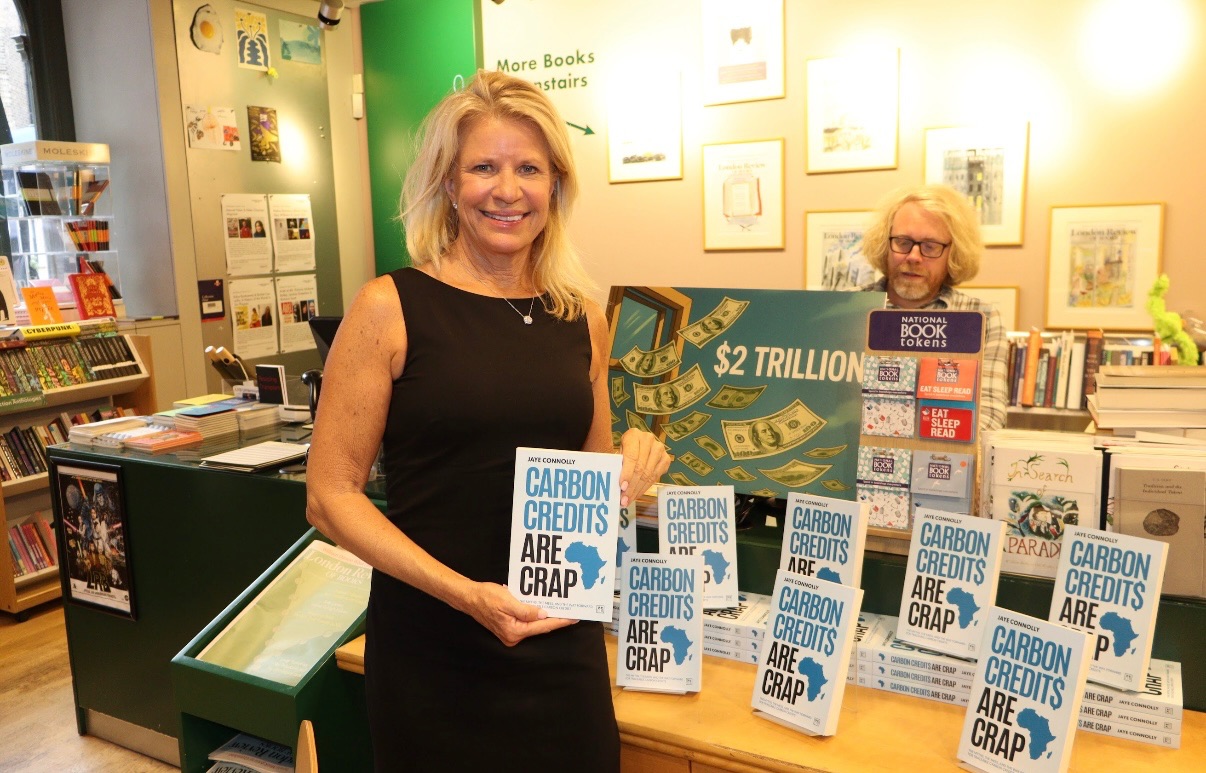
We caught up with Jaye at her London book launch and left energized by her clarity, her courage, and her commitment to flipping the script on the climate economy.
With- Jaye Connolly, author of Carbon Credits Are Crap, during her London book launch.
This isn’t just about climate. It’s about accountability.
To communities.
To consumers.
To the continent that’s been treated as an offset dumping ground for too long.
Carbon Credits Are Crap is available now — and it’s a must-read for anyone ready to stop talking sustainability and start demanding truth.
If we can track a pizza, we can track a carbon credit.
The time for transparency is now — and accountability isn’t optional.
Want to go deeper?
Reach out to Jaye Connolly directly to learn more about how digital tools can clean up carbon markets and create real climate equity.

More with Jaye Connolly at her London Book Launch
Join the crusade to end the climate circus.
It’s time to stop the charade — and start building a system that actually works.

Jaye Connolly at the London Book Launch of Carbon Credits Are Crap
At Britech Group, we are honored to collaborate with innovative minds in the tech industry who are driving impactful change and heightening awareness on crucial issues like carbon credits. As we join forces with these visionaries, we are eager to assist you with your next hiring challenge, bringing the best talent to fuel your mission for a successful future. Let’s create meaningful change together. Explore our past scientific and tech blogs here.