

Antarctic Ice Sheet Insights: Revolutionizing Climate Research through Advanced Lidar Technology
Importance of the Antarctica Ice Sheet
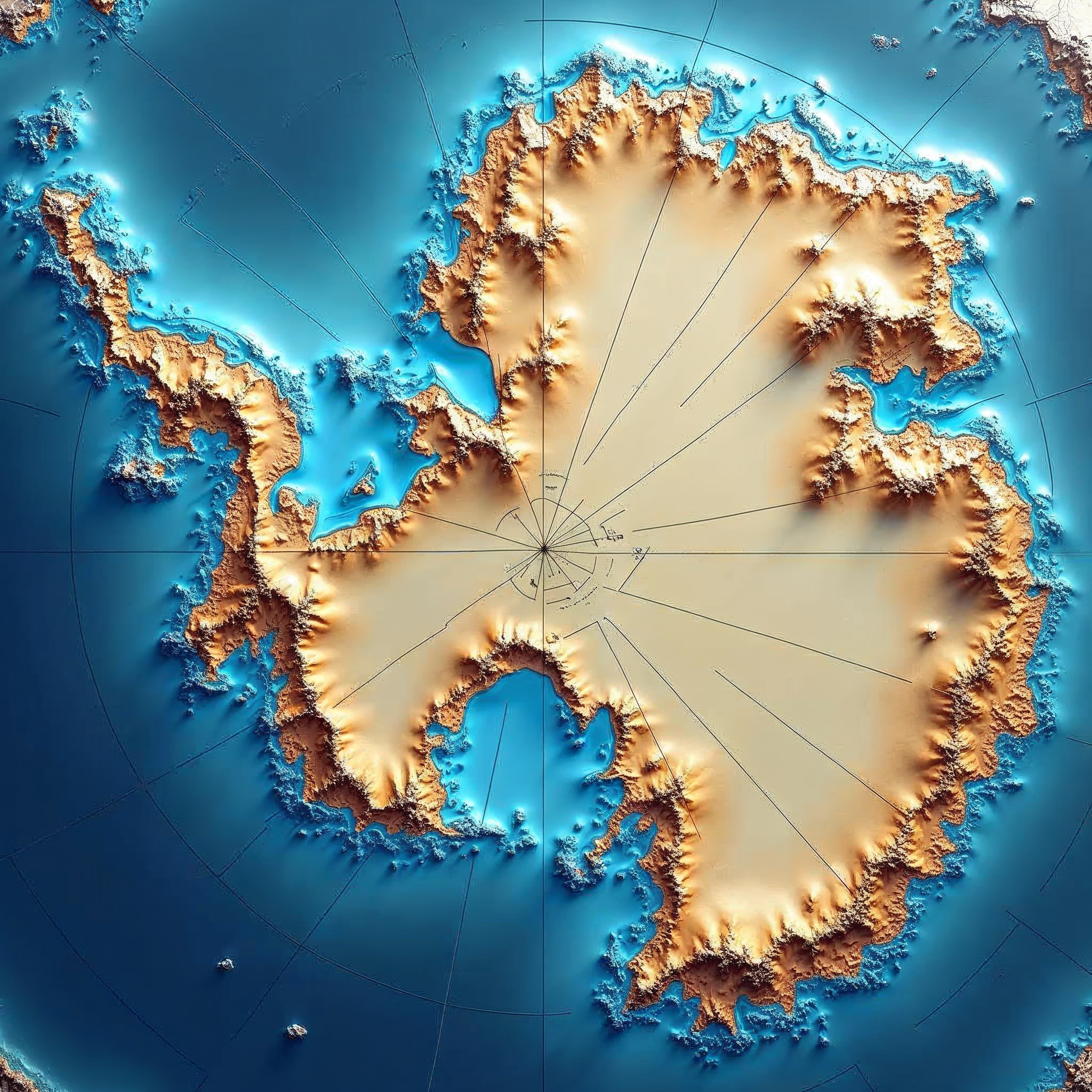
The Antarctica ice sheet undoubtedly offers vital information about our planet’s climate history and future, so its study is crucial to climate change research. Lidar technology marks a key advancement, thus offering a powerful means to uncover the subglacial landmass hidden below the ice. The BedMachine Antarctica project leads these efforts, consequently giving unprecedented insights into the continent’s ice dynamics and geological features. By using remote sensing techniques, scientists achieve remarkable precision in monitoring ice sheet changes, thereby adding valuable data to glacial studies. This research, therefore, enhances our understanding of Antarctica’s systems and informs global strategies to tackle climate change challenges.
Role of Lidar Technology in Ice Sheet Study
Lidar technology has truly revolutionized our study and monitoring of ice sheets, especially in challenging environments like Antarctica. In this section, we will examine Lidar’s role in ice sheet monitoring and recent advancements in remote sensing.
How Lidar Works
Lidar, which stands for Light Detection and Ranging, is essential for ice sheet monitoring. It uses laser pulses to measure distances, thereby creating detailed 3D maps of the Earth’s surface.
Accuracy in Measurements
In Antarctica, Lidar helps measure ice sheet thickness and surface elevation accurately. These measurements are indeed crucial for understanding ice dynamics and predicting changes.
NASA’s Goddard Space Flight Center’s Role
NASA’s Goddard Space Flight Center is a leader in using Lidar for ice sheet monitoring. Their satellite-based Lidar systems thus offer continuous, high-resolution data on ice sheet changes.
Combining Lidar with Other Techniques
Furthermore, Lidar data, combined with other remote sensing techniques, allows researchers to track changes in ice volume over time. This information is vital for assessing the impact of climate change on polar regions.
Recent Advances in Remote Sensing
Remote sensing technology, in general, has advanced significantly in recent years, consequently enhancing our study and monitoring of the Antarctica ice sheet. These advancements lead to more accurate data collection, which is beneficial for researchers.
Interferometric Synthetic Aperture Radar (InSAR)
One advancement is the development of interferometric synthetic aperture radar (InSAR). This technique indeed enables precise ice sheet velocity measurements, identifying areas of rapid change.
Satellite-Based Gravity Measurements
Moreover, satellite-based gravity measurements, such as those from the GRACE mission, complement Lidar data by providing information on ice mass changes. This multi-sensor approach undoubtedly improves ice sheet monitoring accuracy.
Data Access and Analysis
The National Snow and Ice Data Center provides access to various remote sensing datasets. This enables researchers to combine different data sources for comprehensive analysis. Furthermore, improvements in data processing and machine learning algorithms also enhance our remote sensing data interpretation. This, in turn, leads to more accurate predictions of ice sheet behavior.

Contributions of the BedMachine Antarctica Project
The BedMachine Antarctica project represents a major advancement in understanding the continent’s subglacial topography. Here we explore its contributions to mapping the hidden landmass, as well as its impact on glacial studies.
Detailed Mapping of Subglacial Landscape
The BedMachine Antarctica project has produced the most detailed and accurate map of Antarctica’s subglacial landscape to date. This is achieved through integrating various data sources and advanced modeling techniques.
Integrated Data Sources
The project combines data from ice-penetrating radar, seismic measurements, and satellite observations. This creates a comprehensive picture of the bedrock beneath the ice sheet. As a result, this integrated approach allows for unprecedented accuracy in mapping subglacial features.
Key Findings and Discoveries
A key finding from the BedMachine project is the discovery of previously unknown subglacial valleys and mountain ranges. These features play crucial roles in ice flow dynamics and can influence ice sheet stability.
Significance in Glaciology
The Earth System Science Data journal published a detailed description of the BedMachine Antarctica methodology and results, thus emphasizing its significance in glaciology.
Applications in Ice Sheet Models
The high-resolution bed topography maps produced by the project are essential for improving ice sheet models. They help predict future sea-level rise more accurately.
Impact on Glacial Studies
The BedMachine Antarctica project has surely contributed to glacial studies, giving researchers valuable data and insights into ice sheet dynamics. By revealing the subglacial topography, the project has undoubtedly improved understanding of ice flow patterns and potential instabilities. This information is crucial for predicting how the ice sheet will respond to climate change.
Identifying Vulnerable Areas
The project has identified areas where warm ocean water potentially infiltrates beneath the ice sheet, thus accelerating melting. This knowledge is vital for assessing the vulnerability of Antarctica regions to future warming.
Improving Predictions
Researchers can now use BedMachine data to create more accurate ice sheet models, leading to better forecasting of future ice loss and sea-level rise. The Antarctic Glaciers website offers access to these datasets for further research and analysis.
Broader Implications
The project’s findings have implications beyond glaciology. They further contribute to understanding Antarctica’s geological history and the continent’s role in global climate systems.
Impact on Climate Change Research
The insights gained from advanced ice sheet monitoring techniques and BedMachine Antarctica have profound implications for climate change research. In this section, we examine their impact on the understanding of the Antarctica ice sheet, as well as future monitoring prospects.
Revealing the Ice Sheet’s Complex Nature
The detailed mapping and monitoring of the Antarctica ice sheet have revealed its complex and dynamic nature, challenging previous assumptions about its stability in the face of climate change.
Vulnerability to Warming
Recent studies have shown certain regions of the ice sheet are more vulnerable to warming than previously thought. This vulnerability is often linked to underlying bedrock topography and warm ocean currents.
Accurate Predictions of Ice Loss
The improved understanding of ice sheet dynamics has led to more accurate predictions of future ice loss. Some models now even suggest the rate of ice loss could accelerate more rapidly than earlier estimates indicated.
Implications for Sea-Level Rise
These findings have significant implications for global sea-level rise projections. The potential for faster ice loss in Antarctica could lead to higher sea levels in the coming decades, which would affect coastal communities worldwide.
Future Prospects for Ice Sheet Monitoring
The future of ice sheet monitoring indeed looks promising with ongoing technological advancements and international collaborations. These efforts pave the way for precise and comprehensive observations.
Improved Satellite Technology: Future missions will likely feature enhanced Lidar and radar capabilities, which will allow for more frequent and higher-resolution ice sheet monitoring.
Artificial Intelligence and Machine Learning: These technologies will increasingly process and analyze the vast amounts of data generated by monitoring efforts.
Autonomous Underwater Vehicles: These devices undoubtedly will enable more detailed observations of ice-ocean interactions, a critical factor in ice sheet stability.
Integration of Multiple Data Sources: Future efforts will likely combine data from various sources, including satellites, airborne surveys, and ground-based measurements. This will create a more comprehensive picture of ice sheet dynamics.
International Cooperation: Continued collaboration between scientific institutions and countries will be crucial for maintaining long-term monitoring programs and sharing data and resources.
These advancements will enable scientists to track changes in the Antarctica ice sheet with unprecedented accuracy, thus providing valuable insights for climate change research and policy-making.
BriTech Group, Inc.
BriTech Group plays a pivotal role in connecting talented engineers with leading companies at the forefront of cutting edge technology advancements and other leading innovations. Our expertise helps bridge the gap between demand and supply of skilled technical personnel, fostering a dynamic environment for growth and innovation. To explore more about our spotlights on pioneering technology and innovation, check out this article. For more information about our services, visit Britech Group